


Do you really need to disavow backlinks today?

Gerry White • July 28, 2025

Short answer, no

For years, the SEO community has been obsessed with identifying and disavowing "toxic" backlinks. We've spent countless hours poring over link audit tools, flagging supposedly harmful links, and submitting disavow files to Google. However, after observing the evolution of Google's algorithms and the actual impact of these practices, I've significantly changed my stance on this approach.


The Problem with "Toxic" Link Tools

Most backlink analysis tools are quick to label links as "toxic" or "harmful," but the reality is far more nuanced. These tools often flag links that are simply noise—low-quality links that point to virtually every website on the internet. You'll frequently see these patterns with directories or aggregation sites that have names like "Top Sites" or similar generic monikers.


The truth is, these links aren't toxic—they're just irrelevant. They're the digital equivalent of background noise, and Google has become remarkably sophisticated at recognising and ignoring them. When a tool flags thousands of links as problematic, it's worth questioning whether the real problem lies with the algorithm making these determinations rather than the links themselves.


Google's Evolution in Link Handling


Google's approach to low-value links has matured considerably over the past few years. Rather than penalising websites for poor-quality inbound links, the search engine has largely moved towards simply ignoring them. This shift makes perfect sense from Google's perspective—why punish website owners for links they cannot control?

This evolution means that the vast majority of links flagged by audit tools are simply being discounted rather than causing active harm to your website's rankings. Google's algorithms have become adept at identifying natural link patterns and filtering out the noise, making the obsessive pursuit of link disavowal largely unnecessary for most websites.


When Disavowal Still Makes Sense


That said, there are still circumstances where I would consider recommending a disavow file, though these situations are increasingly rare. The primary red flag I look for is a pattern of oddly off-brand but exact-match keyword links, particularly when these links appear across multiple pages with similar content.

For example, if you run a boutique marketing consultancy and suddenly acquire dozens of links with anchor text like "cheap marketing services" or "discount SEO packages" from unrelated websites, this could indicate a negative SEO attack or poorly executed link-building campaign. In these cases, the links don't just lack value—they actively misrepresent your brand and could potentially confuse Google's understanding of your website's focus.


The Shift Towards Quality Preservation


The broader trend in SEO has moved away from damage limitation towards quality preservation. Rather than spending time identifying and disavowing potentially harmful links, the focus should be on building high-quality, relevant links that genuinely enhance your website's authority and relevance.


Google's penalties for backlink issues have become fewer and farther between, largely because the search engine has become better at automatically handling these situations. The energy once spent on link audits and disavowal files is better invested in creating valuable content that naturally attracts quality links and building relationships within your industry.

A More Strategic Approach


This doesn't mean we should ignore our backlink profiles entirely. Regular monitoring remains valuable for understanding how your content is being received and shared across the web. However, the response to discovering low-quality links should typically be to simply carry on with your quality content and link-building efforts rather than rushing to disavow.


The exception, as mentioned, is when you identify clear patterns of manipulative or misleading links that could genuinely confuse search engines about your website's purpose or quality. In these cases, a targeted disavowal focusing specifically on the problematic patterns makes sense.


Final thoughts


The SEO industry's relationship with link disavowal has been characterised by overcaution and tool-driven paranoia. As Google's algorithms have become more sophisticated, the need for aggressive disavowal has diminished significantly.


Rather than spending time battling largely harmless link noise, SEO professionals would be better served focusing on creating excellent content, building genuine relationships, and earning links that truly enhance their websites' authority and relevance. The future of link building lies not in what we remove, but in what we create and earn through quality work.

Gerry White is an SEO consultant specialising in sustainable, quality-focused search marketing strategies.

By Gerry White April 14, 2026
Most of us have developed a reflex: privacy policy appears, thumb moves to "Accept", life continues. We do it on websites, apps, and now, apparently, televisions. But recently, while setting up a new Samsung TV, something stopped that reflex in its tracks. The list of "partners" the TV intended to share data with was 263 companies long. In the video I know I said 400, but still, 263 is far hight than I was expecting That moment of "privacy shock" — feeling invaded in your own living room — is worth unpacking properly. Because the real issue isn't whether you clicked accept. It's whether any of us genuinely understand what we're accepting, why it exists, and whether our collective response to it is calibrated correctly. So what actually is a cookie? Cookies started life as a genuinely useful piece of web plumbing. In 1994, Netscape engineer Lou Montulli invented them to solve a basic problem: websites had no memory. Every page load was a blank slate. Cookies gave sites a way to remember you — your shopping cart, your login, your preferences. A cookie is simply a small text file. A website writes it to your browser; your browser sends it back every time you return to that site. That's it. At their most innocent, they're the reason you don't have to log back into Gmail every twenty minutes. The complication comes in two flavours. First-party cookies are set by the site you're actually visiting and are broadly benign. Third-party cookies are set by someone else — an advertiser, an analytics provider, a social media widget — embedded on that page. These can follow you across the internet, building a profile of your behaviour across hundreds of sites you've never consciously engaged with. On a smart TV, there are no traditional cookies — but the principle is identical. Your viewing habits, your app usage, the content you pause, rewind, or abandon — all of it becomes data. And that data travels. The four types of cookie (in plain language) Strictly necessary Keeps you logged in. Remembers your basket. Non-negotiable for a working site. Functional Saves your preferences — language, region, layout. Useful, low-risk. Analytics Tells the site owner how pages are used. Can be anonymised — often isn't. Advertising / targeting Builds a profile of you. Shares it. Follows you around the web. This is the one. Are we panicking about the wrong thing? Here's the honest tension: most people are simultaneously over-informed and under-informed about cookies. They know they exist, they've been conditioned to feel vaguely threatened by banners, and they've developed coping strategies — clicking accept as fast as possible to make the banner disappear. That's not privacy-conscious behaviour. That's banner fatigue wearing a privacy-conscious costume. The genuine concern isn't that a website knows you visited it twice this week. It's the aggregation: dozens of data brokers combining your TV viewing, your web browsing, your location data, your purchase history, and your search behaviour into a single commercial profile that you never consented to and can't easily inspect. Meanwhile, real risks go unnoticed. People use the same password everywhere, click phishing links in emails, and connect to public Wi-Fi without a VPN — yet feel virtuous about occasionally clicking "reject all" on a cookie banner. The 400-partner list on a Samsung TV is extreme, but it's a useful data point. It illustrates that the modern "consent" model is largely theatrical. No one is reading 400 partner policies. The consent architecture is designed to be accepted, not interrogated. GDPR tried to address this; the results have been mixed at best. What can you actually do? On smart TVs specifically: dig into the privacy settings menu rather than accepting the onboarding prompt. Most Samsung and LG TVs have an "interest-based advertising" toggle buried several menus deep — turn it off. Disable ACR (Automatic Content Recognition) if you can find the setting; this is the technology that monitors what you're watching in real time. On the web: a browser extension like uBlock Origin blocks the trackers that cookie banners are trying to legitimise. Choosing "reject all" on cookie banners, where that option is clearly presented, takes thirty seconds and meaningfully reduces your third-party data trail. More broadly: understand the difference between the data you're comfortable sharing (anonymous usage stats, session preferences) and the data that builds a profile of you (cross-site behavioural tracking, location, purchase intent). Make decisions at that level, not at the level of individual banners.
By Gerry White March 17, 2026
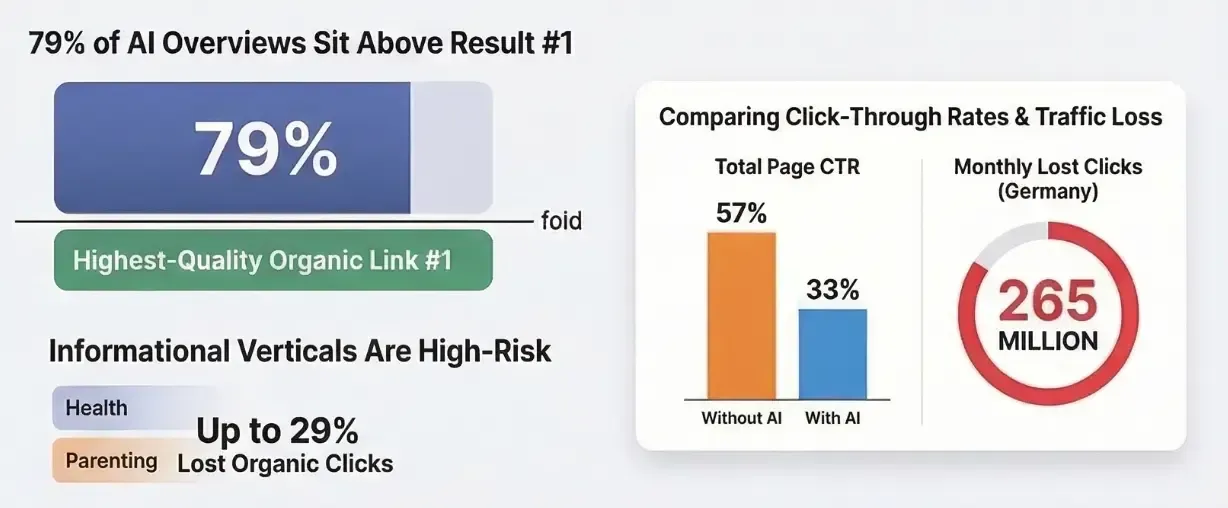
Google, the AI Race and the Organic Traffic Price

Buzz word bingo
By Gerry White July 28, 2025
When we keep changing what we call ourselves, we're essentially telling the world that our previous work was wrong or outdated. That's nonsense. The technical SEO work I did ten years ago is still serving websites well today. The content strategies that worked in 2015 are still driving traffic and conversions.
By Gerry White July 27, 2025
This is a subtitle for your new post