Everyone has been saying it for long enough, Google isn’t sending traffic unless it has to, or you pay for it, Sistrix has published some research in German (Google translate for the win) others have published similar. A couple of my clients, particularly travel and education have seen some crazy CTRs from top results as a result of AI overviews.
The headline finding is stark: when a Google AI Overview appears in search results, clicks to the top organic result fall by almost 60%, this is huge, especially if you aren’t in the top one or two spots. Websites that have spent years and in many cases, millions building authoritative, high-quality content, sharing it with Google in return for traffic, I know that many argue that traffic isn’t the KPI that many businesses should be tracking, however the creation of high quality travel guides that are freely accessible and shareable leads to brand exposure, this brand exposure leads to brand preference, trust and ultimately revenue, so high quality content could be attributed to to revenue
Google is taking the answer and giving the user just enough attribution to call it fair, a source link, a small citation, barely noticeable beneath a comprehensive AI-generated summary of the content your team crafted.
Google Is Now Winning the AI Race - By a Significant Margin
To understand why organic CTR is falling so sharply, you first need to understand the broader strategic context. In December 2022, Google famously declared internal 'Code Red' when ChatGPT launched and appeared to threaten its search dominance. Three years on, the situation has almost entirely reversed.
According to analysis by SISTRIX's Johannes Beus, it is now OpenAI facing its own internal alarms as ChatGPT's growth stagnates while infrastructure costs balloon, with projections suggesting the company will need up to $111 billion by 2030 to sustain its operations. Meanwhile, Google's Gemini platform tripled its web traffic in the second half of 2025, and AI Overviews now reach over two billion monthly users globally.
Google's advantages are structural and, at this point, likely insurmountable for any challenger. They can be grouped into three areas:
- Access: AI Overviews are baked into the standard search experience. There is nothing to install, no new habit to form. Google meets users exactly where they already are, and one click to AI mode.
- Economics: Google's proprietary TPU chips operate at near-manufacturing cost and are significantly more energy-efficient than the NVIDIA GPUs OpenAI relies on creating an estimated three-to-five times cost advantage.
- Integration: Gemini is natively embedded within Gmail, Docs, Sheets, YouTube, Maps and Calendar, plus locked in as the AI backbone for Apple Intelligence and Siri. This ecosystem reach is essentially impossible to replicate from a standing start.
For SEOs and content teams, the lesson from this competitive picture is uncomfortable: the question of whether Google or its challengers wins the discoverability AI race is almost settled. What is not settled is what Google's dominance means for the publishers, brands, and content creators who have built their digital presence in Google's ecosystem. And here, the data is unambiguous.
The Click-Through Rate Collapse: What the Numbers Actually Say
SISTRIX analysed over 100 million keywords in Germany to produce what is currently one of the most comprehensive studies of AI Overview impact on organic search behaviour. While Germany is the primary dataset, the structural forces at play are not market-specific they are intrinsic to how AI Overviews function, and findings are being replicated in every market where the feature has rolled out.
Here are the core findings:
- AI Overviews appear on approximately 20% of all keywords in Germany, with the rate rising to around 30% for longer, more conversational queries.
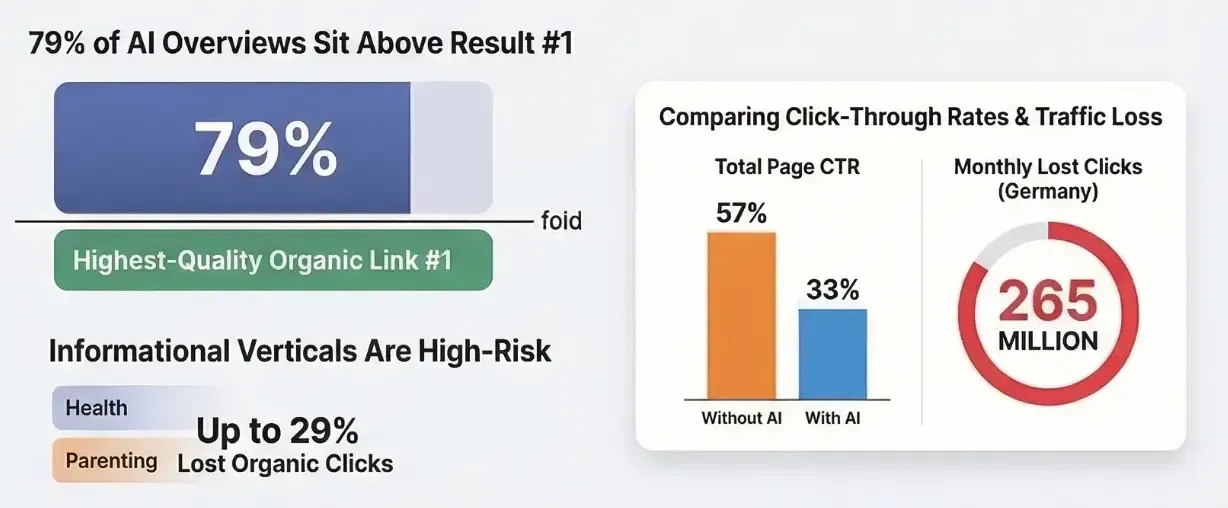
- Nearly 79% of AI Overviews are positioned above the first organic result meaning they are the first thing users see.
- On searches where an AI Overview appears, the click-through rate for Position 1 drops from an average of 27% to just 11%. That is a loss of nearly 60% of clicks at the very top of the results page.
- The overall click-through rate for a search with an AI Overview falls from 57% to 33% meaning nearly half of all clicks that would previously have gone to organic results are now absorbed by Google itself.
- In absolute terms, this represents approximately 265 million lost organic clicks per month in Germany alone.
Google has pointed out that AI Overviews generate around 10% more total search queries. But this is something of a sleight of hand: more searches at a lower click-through rate per search does not compensate publishers for the volume of traffic being absorbed. The pie may be fractionally larger, but Google is taking a dramatically bigger slice.
It is also worth being precise about what is happening mechanically. AI Overviews are not simply summarising the web in abstract terms. They are synthesising content from specific publisher pages content those publishers invested in creating and presenting it as a complete answer, with source citations that are easy to miss and rarely clicked. The content does the work. Google takes the traffic.
Not All Sectors Are Equal: The Industries Losing Most
One of the most important dimensions of the SISTRIX research is the breakdown by content category. The headline average of 66% total click loss understates the damage for anyone operating in informational content verticals. The impact varies enormously by sector from under 1% for some transaction-focused sites to over 24% for others.
The pattern is consistent and logical once you understand the underlying mechanism. Google is most aggressive with AI Overviews on informational queries searches where users are looking for an explanation, a definition, a recommendation, or an answer to a question. These are precisely the queries that drive traffic to editorial, educational, health, travel advisory, and financial guidance content.
From what I have observed directly across client work in travel and education, this maps precisely onto real-world traffic patterns. Destination guides, course comparison pages, visa information articles, curriculum explainers, all of these fit squarely into the informational query category that AI Overviews are designed to answer. In travel especially, the irony is acute: these are the pages that took the most effort to produce, required genuine expertise, and in many cases involved on-the-ground research. They are also exactly the pages Google can now summarise in a paragraph.
The SISTRIX data shows the largest proportional losses concentrated in health and parenting sites, specialised portals losing over 29% and 24% of their organic clicks respectively. But the underlying dynamic is the same across education, travel, personal finance, and home services: if your content primarily exists to answer questions, Google now competes with you directly.
At the other end of the spectrum, transactional sites - e-commerce, travel booking platforms, price comparison tools are largely insulated. Google does not show AI Overviews for shopping queries at present, and booking-oriented searches see minimal click loss. If your content drives the transaction itself rather than answering a question that precedes it, you are currently safer. But 'currently' is doing significant work in that sentence, Google Merchant Centre here is what is dominating, and this will be closely integrated with Gemini and the SERPs.
The Attribution Problem: A Citation Is Not the Same as a Click
One of the recurring arguments in Google's defence of AI Overviews is that sources are cited that publishers whose content is synthesised receive a link in the AI Overview box. This framing misunderstands what publishers need from search, and what the data actually shows about citation behaviour.
A citation inside an AI Overview box is not equivalent to a ranked organic result. The click-through dynamics are entirely different. Users who receive a complete, well-formatted answer from Google's AI have minimal motivation to follow a source link, particularly when that link appears below the fold, in small text, among several competing citations.
For businesses, this distinction matters enormously. An organic click typically represents genuine user intent, someone who wanted to read your content, evaluate your product, or engage with your service. A citation mention in an AI Overview may mean your content was useful to Google's training pipeline, but it delivers none of the downstream commercial value that organic traffic historically provided: time on site, brand exposure, email sign-ups, conversions.
I have seen this play out directly across clients in both travel and education. Visibility metrics remain reasonable, impressions are stable (and in some cases growing as AI Overviews surface content for a wider range of query variants). But click volume is falling, and with it the business outcomes that justified the content investment in the first place. Being referenced is not the same as being visited.
Search Volume as a Metric Is No Longer Sufficient
One of the most significant practical implications of the SISTRIX research is the challenge it poses to how we evaluate keyword opportunity. Search volume has always been a proxy for potential traffic, but in the era of AI Overviews it has become actively misleading.
A keyword with 10,000 monthly searches and a 27% average CTR for Position 1 delivers a fundamentally different commercial opportunity than the same keyword with an AI Overview and an 11% CTR at Position 1. In the former case, you might expect around 2,700 clicks for the top organic result. In the latter, that same position delivers approximately 1,100. More than 1,500 clicks per month evaporate and those clicks do not go to Position 2. They go to Google.
Any content strategy or editorial roadmap that is still being built purely on search volume data is now operating with a significant blind spot. Keyword prioritisation needs to account for AI Overview presence, the nature of the query (informational vs. transactional), and the estimated real-world CTR given the SERP layout not just the theoretical maximum.
The goal post has moved, and the measurement framework needs to move with it.
What This Means for Content Strategy: A Practical Framework
The data makes clear that not all content is equally at risk, and not all responses to this shift are equally effective, for every client, the action is different, does traffic matter as much as sentiment and exposure, how do users convert.
1. Prioritise depth that AI cannot compress
AI Overviews are very good at summarising. They are considerably less capable of replacing content that requires depth, nuance, narrative structure, or original data. Long-form investigative pieces, proprietary research, detailed methodology breakdowns, and genuinely expert commentary are harder to synthesise without significant loss of value. The recipe category in the SISTRIX data with only a 1% click loss is instructive here: step-by-step instructional content that users need to follow in real time is difficult to replace with a paragraph.
2. Invest in proprietary data and original insight
Content derived from original research, surveys, internal data, or expert interviews cannot be fully replicated by an AI that draws on publicly available training data. If your organisation has access to unique data booking patterns, student outcomes, customer feedback, expert networks that data should be the foundation of your editorial strategy, not an occasional feature.
3. Reconsider the informational content model for pure traffic plays
Content built to answer simple informational queries ‘'what is X', 'how does Y work', 'best Z for beginners' is now in direct competition with Google's own AI. The question is not whether to abandon these queries, but whether the traffic they deliver justifies the production cost in a post-AI Overview landscape. For some, the answer will still be yes, particularly where the informational content serves a clear conversion funnel. For others, there may be better investments.
4. Optimise for citation, not just ranking
The relevant success metric may shift from organic ranking and click volume towards 'mentions and citations' being referenced as a source within AI-generated answers. This is already emerging as a distinct discipline. It requires the same technical foundations as traditional SEO (site authority, structured data, crawlability) but also demands clear signals of expertise, editorial credibility, and source trustworthiness.
5.
Diversify traffic sources while organic remains viable
Brands that have built their digital businesses entirely on organic traffic from informational content are carrying a concentration risk that is only growing. Email lists, direct channels, brand search, and referral traffic from genuine communities all become more strategically important when the primary distribution channel is actively pulling traffic back toward itself.
The Uncomfortable Truth and What Comes Next
The SISTRIX research is a fantastic piece of work precisely because it gives us solid evidence around the AI Overview debate. We have known anecdotally, from Search Console data, from client conversations, from our own sites that something was shifting. Now we have numbers.
And the numbers tell a specific story: Google is not merely changing how search results look. It is changing who captures the value created by the web's content. The content creator produces the answer. Google synthesises it, presents it, and absorbs the click. A small attribution appears below the fold.
For publishers, brands, and content teams operating in high-information sectors travel, education, health, finance, SAAS services, this is not a trend to monitor cautiously. It is an active, ongoing redistribution of value that requires a strategic response now. The businesses that adapt their content models, their measurement frameworks, and their channel mix in 2025 and 2026 will be significantly better positioned than those waiting to see how the dust settles, sounds easy right?
Further Reading
Johannes Beus, SISTRIX — 'AI Search: How Data Shows That Google Is Winning' (March 2026):
https://www.sistrix.de/news/wie-daten-zeigen-dass-google-gewinnt/