
Pirate metrics are back, and AI search is the reason
In 2007 Dave McClure gave a talk called "Startup Metrics for Pirates". Five stages: Acquisition, Activation, Retention, Referral, Revenue. Say the acronym out loud and you get AARRR, which is why everyone calls them pirate metrics. It's a bit daft, and that's probably why it stuck. Nearly twenty years later product and growth teams still use it all the time.
SEO, on the other hand, has mostly lived in the first letter.
That made total sense at the time, and SEOs got very good at it. The job was built around getting people to the site, and then somebody else took over: CRO, product, CRM, whoever owned the email list. The click was the handover point. Rankings, impressions, clicks, sessions are all acquisition metrics. On a good day we'd report organic conversions too, but everything in between belonged to another team.
I think that's changed a lot, and LLMs are why. Say someone asks ChatGPT "what's the best accounting software for a freelancer in the UK?" A big chunk of the funnel happens before they get to your site, and plenty of people never get there at all. So if you're only measuring the click, you're measuring the very end of a journey and guessing the rest.
So in this post I want to make the case that AARRR fits GEO much better than it ever fitted classic SEO. Then I'll get into the useful bit, which is how to set it up and track it. It's a long one, so maybe get a brew first.
A quick refresher
If you missed the startup phase of your career, here's the original framework in one table:
| Stage | McClure's question | Typical startup metric |
|---|---|---|
| Acquisition | Where do people find you? | Visits by channel |
| Activation | Do they have a good first experience? | Sign-ups, first key action |
| Retention | Do they come back? | Returning users, churn |
| Referral | Do they tell other people? | Invites, shares, word of mouth |
| Revenue | Do they pay? | Conversion, revenue per user |
The point people forget is that McClure wasn't giving you five numbers to stick on a dashboard. He was describing a chain of conversion rates. You find the stage that leaks worst and you fix that one first. Hold onto that idea, because it's the whole reason this matters for AI search.
I should say where I picked all this up. It was from Yara Paoli, who gave a great talk at Turing Fest called "What is the Best Structure for Growth?". The thing that stuck with me most is that AARRR isn't really a funnel, it's a loop. Draw it as a funnel and people fall out the bottom, and that's the last you see of them. In a loop, happy customers tell other people, those people become your next lot of acquisition, and the whole thing feeds itself.
I'll be honest, though. I always rated it as a marketing framework, but it never fully lined up with SEO. It was close without quite fitting. Search sat at the top as an acquisition channel, and the loop part (customers going off and talking about you) happened somewhere SEO couldn't see or do much about, apart from the odd backlink. Reviews were something the CRO team put on product pages, or a local SEO thing for Google Business Profiles.
That's changed pretty much overnight. What people say about you, in reviews more than anywhere, now feeds straight back into whether a model recommends you. And because the models are multimodal now, it isn't only the written reviews. YouTube walkthroughs, unboxing videos, photos people post of your product, a mention on a podcast: the models can read, watch and listen to all of it, and it all goes into the answer. So the loop finally runs through search, and reviews have gone from a nice-to-have to one of the most important things you can work on.
Why classic SEO could get away with just the first A
Old-school search gave you ten blue links, and the searcher did the comparing themselves. They opened five tabs, skimmed, bounced back, and opened another tab. Google's part ended at the click and ours more or less started there, so SEO measured the bit Google controlled: did we show up, and did they click.
Even the R's weren't really ours. In SEO "referral" meant backlinks, and we saw them as a ranking input, not a stage of the customer's journey. Retention belonged to CRM. Revenue was something we reported on, but through attribution models that were never really built for search.
That was fine, because the model was deterministic enough to work with. You had a position, the position had a CTR curve, the CTR gave you traffic, and the traffic gave you a conversion rate. It wasn't perfect, but it was one straight line.
AI search breaks that line in a few places.
What's different now
1. The click no longer tells the whole story
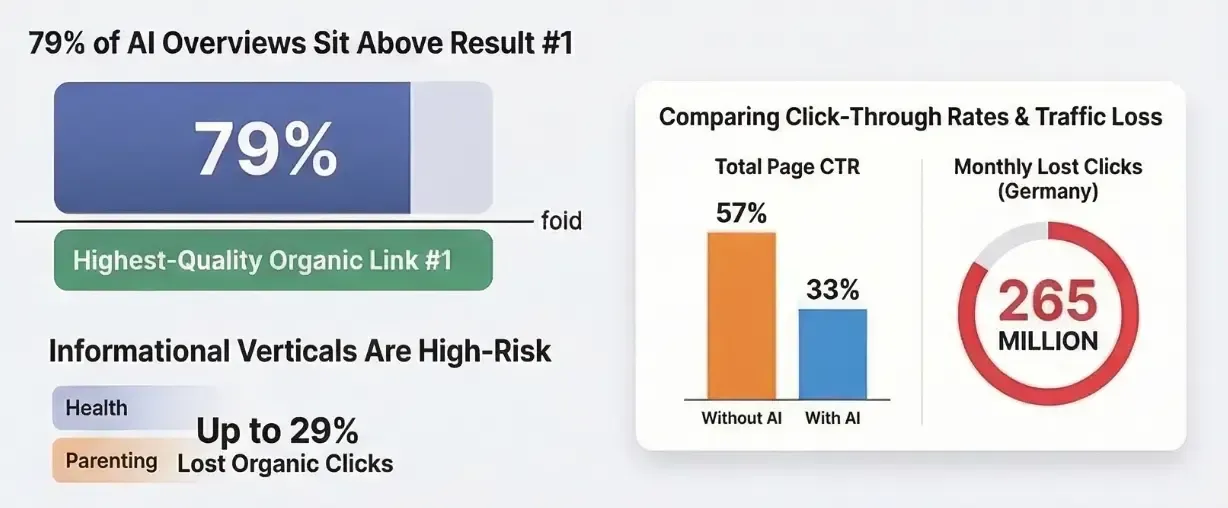
You've seen the numbers, but here they are anyway. Ahrefs looked at 300,000 keywords using December 2025 Search Console data and found the number one result gets 58% fewer clicks when an AI Overview appears. Seer Interactive looked at 2.43 billion impressions across 53 brands and put the drop in organic CTR at 61% on queries with AI Overviews.
So the click, the thing we've spent two decades optimising for, isn't the scoreboard anymore. At least it's not the whole scoreboard. People are getting their answer and making their decision somewhere you can't see.
2. The people who do click aren't the same people
This is where it gets messy, so tread carefully. You'll see a lot of "AI traffic converts 9x better!" posts on LinkedIn, and the research doesn't agree with itself:
- Visionary Marketing's dataset of 14.7 million AI sessions had AI referrals converting at 4.21% against 1.94% for Google organic. In the same data, AI search was only 1.84% of organic traffic.
- A Visibility Labs study reported by Search Engine Land had ChatGPT converting 31% better than non-branded organic (1.81% vs 1.39%). Average order value was lower though, $204 vs $238.
- A study of 973 ecommerce sites found the opposite: ChatGPT referrals converted worse than Google search, email and affiliate.
- And on raw volume, Google organic still drove 27 times as many conversions as all the LLMs put together in one dataset.
So which is it? It depends on your vertical, your price point and how you've set up your tracking. Most of them agree on one thing though: fewer visits, and the people who do turn up have already done a lot of the work. Visibility Labs calls this "intent compression", which I like. The comparing, the shortlisting and the "is this any good" questions happened inside the chat.
In AARRR terms, the user turns up partway down your funnel. And if you only track the click, you have no idea which stages they skipped or what they were told along the way.
3. The model does the comparing now
In 2015 the user opened five tabs. In 2026 the model opens them, and I mean that literally. When someone asks ChatGPT a question that needs fresh info, a bot called ChatGPT-User
goes and fetches pages in real time, reads them for the user, then writes them a summary.
Your pricing page could be read, summarised and judged on behalf of someone who never visits your site. That's activation happening on somebody else's platform. Your landing page used to get the chance to make a first impression. Now the model gets it first.
4. Referral now feeds straight into acquisition
This is the one I think people underrate. LLMs build their answers out of what other people say about you: review sites, Reddit threads, comparison articles, YouTube transcripts, press coverage. Your own website is one voice among many, and often not the loudest.
So McClure's Referral stage, people talking about you, isn't something that happens after a customer has a good experience anymore. It's one of the main inputs into whether you get recommended at all. This is Yara's loop, and it's very easy to see in AI search: what people say about you today decides whether the model recommends you tomorrow.
5. And there's no such thing as a ranking
SparkToro and Gumshoe ran a study with 600 volunteers putting 12 prompts through ChatGPT, Claude and Google's AI 2,961 times. The chance of getting the same list of brands twice was under 1 in 100. Getting the same list in the same order was under 1 in 1,000.
So "we rank third in ChatGPT" doesn't mean anything. But, and this is the bit that matters, the study also found that the set of brands the models drew from stayed fairly stable for a given intent. The order's a lottery. Being in the pot, much less so.
You can't track a position, but you can track a probability. How often do you show up? How often do you get cited? How often is the description right? How often does that turn into a visit, and how often does the visit convert?
Those are rates across a multi-stage journey. That's exactly what AARRR was built for, and it's my whole argument. Classic SEO handed you a nice clean ranking and a click, so you could manage without a funnel model. AI search takes both of those away.
AARRR, rewritten for AI search
Let's go through it letter by letter. For each one: what it used to mean for SEO, what it means now, and what you should be measuring.
Acquisition: are you in the answer?
Old SEO version: rankings, impressions, clicks, organic sessions.
Now: before anyone can click, you have to be in the answer. So acquisition gets split into a couple of layers:
- Mention rate : the % of sampled responses that name your brand for a given set of prompts
- Citation rate : the % of responses that link to your site as a source (it's a separate thing, because you can be mentioned without being cited and cited without being mentioned)
- Share of voice : your mention rate compared with your competitors' on the same prompts
- AI referral sessions : the visits that make it to your site from AI assistants
- Retrieval activity : how often AI bots are fetching your pages (more on this in the setup section)
Most of the AI visibility tools (Ahrefs Brand Radar, Scrunch, Peec, Profound, Semrush, Sistrix and so on) will give you the first three. GA4 and your server logs cover the last two.
Activation: did the answer get you right, and did the landing page finish the job?
Old SEO version: not something SEO measured. At a push, bounce rate.
Now: two halves, and SEO owns more of both than it used to.
The in-answer half. When the model talks about you, is it right? Wrong pricing, a product you dropped two years ago, the wrong category, a competitor's feature credited to you. All of that is a failed first impression, and it happened before the user got anywhere near you. So track:
- Accuracy rate : of the responses that mention you, how many get the key facts right (price, core features, who it's for)
- Sentiment : is the framing positive, neutral or "it's fine but a bit pricey"
The on-site half. AI visitors don't land on your homepage much. They land deep, on pricing, comparison pages, docs and specific product pages, because the model sent them to the exact page that answered the question. So:
- Engaged session rate for the AI channel, broken down by landing page
- First-session key event rate : did they do the thing (sign up, add to basket, book a demo) in that first visit?
Here's a scenario I'd file under "obvious once you see it". ChatGPT sends someone to a pricing page that's 18 months out of date, and they leave. That's an activation failure, and I'd argue it's now your problem as the SEO, because the model chose that page based on content you're responsible for.
Retention: do you stay in the answer, and do people come back?
Old SEO version: not an SEO metric at all. CRM owned it.
Now: this one has two meanings.
The model keeps you. Your visibility isn't fixed. It moves with every model update, every change in what gets retrieved, and every new competitor that turns up in the citations. So retention here means: are you still in the consideration set this month? Track mention rate week by week, and annotate model releases on your charts the same way you'd annotate Google core updates.
The user comes back. Someone who discovers you through ChatGPT might come back via a branded Google search, or just by typing your URL in. That's where Search Console's branded queries filter is handy. Google launched it in November 2025 and expanded it to all eligible sites in March 2026. Growth in branded impressions is one of the best lagging indicators you've got for AI-driven awareness.
There's a sneaky third one too. Your existing customers are asking LLMs "how do I do X in [your product]?" instead of going to your help docs. If the answer's wrong, that's a support ticket at best and churn at worst. So I'd put a few of those how-to prompts in your tracking set as well, even though nobody would ever have called that SEO before.
Referral: who's vouching for you?
Old SEO version: backlinks, as a ranking factor. Reviews were mostly someone else's job, unless you did local SEO.
Now: this is the big one. When the model answers questions in your category, which sites does it cite? Are you mentioned on them, and are your competitors?
That list of cited domains is basically your referral network now. A review site, a Reddit thread, a "best X for Y" article on a trade publication: each one is a third party vouching for you (or not) to the model, and through the model to the user.
Reviews deserve their own mention here. A model answering "is Ledgerly any good?" has to get its view from somewhere, and real customers saying what they think is about the most useful thing it can find. How many reviews you have, how recent they are and what they say about specific things ("the bank feed kept breaking", "support sorted it in ten minutes") all shape how the model describes you. And it's not only text anymore. A ten-minute YouTube review, an Instagram photo of your product in someone's kitchen or a TikTok moan about your delivery times are all things a multimodal model can take in. If your review strategy is still "put a widget on the product page", you're missing most of what's going on.
What to track:
- Cited domains for your prompt set : which domains come up most often across all responses, not only the ones that mention you
- Your coverage gap : the cited domains where your competitors are mentioned and you aren't
- Reviews on the platforms that get cited : volume, how recent they are, average rating, and the themes that keep coming up (good and bad)
- Video and visual coverage : who's reviewing you on YouTube and social, and whether those videos turn up as sources in the answers
- Third-party mentions over time : are you adding new vouchers, or just sitting on the old ones?
This is where SEO and digital PR end up closer together than they've ever been. The coverage gap list is pretty much a PR target list that writes itself.
Revenue: what's it worth?
Old SEO version: organic conversions and revenue, usually last-click.
Now: the same, but with an honest admission that the click-based number is the floor, not the total.
- Conversions and revenue by AI channel , plus revenue per session (because the volume's small, per-visit value is more useful than the raw totals)
- Self-reported attribution : just ask people. Omniscient found that a free-text "how did you hear about us?" field picked up 6.8 times as many AI-influenced leads as their first-touch attribution. Six point eight. Your analytics is undercounting this, possibly by a lot.
Setting it all up
Right, the practical bit. None of this needs a huge budget, just a bit of patience and a willingness to accept numbers that are fuzzier than you'd like.
Step 1: Build a prompt set and map it to the funnel
This is the foundation, and it's where most people go wrong. They track 20 "best X" prompts, call it done, and end up only measuring acquisition again.
Instead, tag every prompt by stage. Here's an example for a made-up accounting software brand, which I'll call "Ledgerly":
| Stage | Prompt type | Example |
|---|---|---|
| Acquisition | Category discovery | "best accounting software for freelancers UK" |
| Acquisition | Problem-led | "how do I keep track of expenses as a sole trader" |
| Activation | Evaluation | "is Ledgerly any good" |
| Activation | Comparison | "Ledgerly vs Xero for a one-person business" |
| Revenue | Decision | "how much does Ledgerly cost", "does Ledgerly do Making Tax Digital" |
| Retention | How-to (existing users) | "how do I export a VAT return from Ledgerly" |
| Referral | Third-party opinion | "what do accountants recommend for freelancers", "Ledgerly reviews Reddit" |
A few tips:
- Start with 50 to 150 prompts. You can add more later, and it's harder to take them away once someone's grown attached to a chart.
- Vary the wording a lot. In the same SparkToro work, people almost never phrased the same intent the same way. Write three or four versions of each intent, not one.
- Run each prompt lots of times, across platforms. One run is an anecdote. You need enough runs to get a percentage you can trust. Most tools do this for you; if you're doing it by hand, it gets old fast.
- Use your tool's tagging. Most of the AI visibility platforms let you tag prompts by stage, topic or persona. Use it, because it's what turns a big list of prompts into a funnel.
Step 2: Sort out GA4
In mid-May 2026 Google added a native AI Assistant
channel to GA4. Sessions from AI chatbots it recognises get the medium ai-assistant
and land in their own channel automatically. Lovely. But:
- Google hasn't published the full list of assistants it recognises, and it's not clear whether Perplexity is on it
- Anything that arrives without a referrer (in-app browsers, some mobile apps, copy-pasted links) still lands in Direct
So check the native channel first, then build your own custom channel group anyway, as a backstop.
In GA4: Admin → Data display → Channel groups → Create new channel group. Add a channel called "AI Assistants" with the condition Session source matches regex:
.*(chatgpt|openai|perplexity|claude\.ai|gemini\.google|copilot\.microsoft|deepseek|grok|meta\.ai|mistral|you\.com).*
Then move it above Referral . GA4 puts each session into the first channel that matches, so if Referral sits above yours, it'll grab everything first and your shiny new channel will show zero.
A few more nerdy notes:
- ChatGPT tags many of its links with
utm_source=chatgpt.combut doesn't set a medium. Depending on how your setup handles that, those sessions can end up in Unassigned instead of Referral. Matching on source, like the regex above does, catches them either way. - In October 2026 ChatGPT stopped adding the UTM for about a week, and plenty of people saw their ChatGPT traffic "drop" and then come back. So don't panic over a dip until you've checked what changed.
- Custom channel groups work on your historical data too, so you'll get a backfilled trend straight away.
Then build one exploration with AI Assistants channel × Session source × Landing page × Key events. That gives you acquisition (sessions), activation (engagement and first key events by landing page) and revenue (conversions) in one view, broken down by assistant.
Step 3: Read your server logs
This is the bit most marketing teams skip, and I think it's a mistake, because it's the closest thing you'll get to "impression data" for AI search.
The bots to know about:
| User agent | What it's doing | Funnel meaning |
|---|---|---|
GPTBot
, ClaudeBot
|
Collecting training data | Long-term: what the model "knows" |
OAI-SearchBot
, Claude-SearchBot
, PerplexityBot
|
Building a search index | Acquisition eligibility: can you be retrieved at all? |
ChatGPT-User
, Claude-User
, Perplexity-User
|
Fetching a page live because a human just asked a question | Real-time demand, and the page is being "activated" by the model |
The live-fetch bots are the ones I'd watch most closely. A ChatGPT-User
hit on your pricing page means someone, right now, asked ChatGPT something that made it go and read your pricing. That's a buying signal, even if no click ever follows.
If your logs use the standard combined format, this gives you a quick top 50:
grep -E "ChatGPT-User|Claude-User|Perplexity-User" access.log \
| awk '{print $7}' | sort | uniq -c | sort -rn | head -50
What to look for:
- Which pages get fetched most? These are the pages being used to answer questions about you, so make sure they're accurate and up to date.
- Status codes. A 404 or a 403 means the bot came looking and left with nothing. That's a lost activation.
- Gaps. Important pages that never get fetched might have crawl, rendering or internal linking problems.
Two caveats. First, user agents can be spoofed, so verify against the IP ranges the AI companies publish (OpenAI, for example, publishes JSON files of its bot IPs). Second, a fetch isn't a citation. Lots of bot activity tells you that you're eligible , not that you're winning.
Step 4: Ask people
Add a "How did you hear about us?" question (HDYHAU, if you like an acronym, and I know you do) to your sign-up, demo or checkout form. Two things make it work:
- Include "AI assistant (ChatGPT, Gemini, Claude, Copilot, etc.)" as an option. If it's not there, people pick "Google" or "Other" and you lose the signal.
- Add a free-text box. The best data comes from people writing "asked ChatGPT for a cheaper alternative to [competitor]", because that tells you the prompt, the stage and the competitor in one go.
It's the cheapest bit of measurement here and quite possibly the most accurate. It also keeps working whatever OpenAI does to its UTMs next week.
Step 5: Watch your lagging indicators
AI exposure leaks out into other channels, so keep an eye on:
- Branded search impressions in Search Console, using the branded queries filter
- Direct traffic
to deep pages (nobody types
/pricing/freelancersfrom memory, so this is often hidden AI or app traffic) - Branded search on Bing , since Copilot sits on top of it
None of these prove AI caused anything on their own. But if your mention rate goes up in March and your branded impressions follow in April, that's a story worth telling.
Step 6: Put it on one page
Here's the dashboard I'd build. One row per letter, and each row is a rate, not a vanity number:
| Stage | The question | Main metrics | Where it comes from | How often |
|---|---|---|---|---|
| Acquisition | Are we in the answer? | Mention rate, citation rate, share of voice, AI sessions | AI visibility tool, GA4, server logs | Weekly |
| Activation | Did the answer get us right, and did the page land? | Accuracy rate, sentiment, engaged session rate, first-session key events | AI visibility tool, manual review, GA4 | Monthly |
| Retention | Are we staying in the set, and do people come back? | Mention rate over time, returning users from AI, branded impressions | AI visibility tool, GA4, Search Console | Monthly |
| Referral | Who's vouching for us? | Top cited domains, coverage gap vs competitors, review volume, freshness and themes | AI visibility tool, review platforms, YouTube/social | Monthly |
| Revenue | What's it worth? | AI conversions, revenue per session, self-reported AI share | GA4, CRM, HDYHAU data | Monthly |
Then do what McClure said: find the leakiest stage and fix that one first. High mention rate but low citation rate? Your content is being used but your site isn't getting the credit, so work on being the source. Good citations but poor activation? Fix the landing pages. Great on-site conversion but a tiny mention rate? Go and get some third-party vouchers.
The caveats (there are plenty)
I don't want to make this sound tidier than it is.
- The research is all over the place. Conversion studies contradict each other. Use your own data, and treat industry benchmarks as a rough sense check, not a target.
- Prompt sampling is noisy. With answers this variable, a 3-point move week on week is probably nothing. Look at trends over a month or more.
- API answers aren't always the same as what users see. Some tools query the API, some scrape the real interface. Know which one yours does.
- Tracking breaks. UTMs disappear, referrers get stripped, Google's AI channel list is incomplete. Build in redundancy (GA4 plus logs plus HDYHAU) so no single breakage blinds you.
- None of it is precise. It's a lot more precise than looking at organic sessions and shrugging, though.
So why does it matter more now?
Because in classic SEO you could get away with measuring one letter. Google gave you a ranking you could see and a click you could count, and everything after that was someone else's job.
With AI search the ranking's gone, a lot of the clicks have gone, and a big chunk of activation and referral now happens on platforms you don't own. You're left trying to measure a journey you can only partly see, using probabilities instead of positions. A framework from 2007 with a silly pirate name turns out to be a really good fit for that, which still makes me smile a bit.
If you're still reporting rankings and organic sessions and nothing else, I'd start with Step 1 and the HDYHAU question. They're the quickest wins, and they'll change the conversation with your stakeholders faster than anything else here.
If you want a hand setting any of this up, whether that's the prompt set, the GA4 config or making sense of your logs, get in touch. I'm always happy to talk about this stuff, probably more than is healthy.